Support our educational content for free when you purchase through links on our site. Learn more
55+ Iconic Clothing Brand Logos Decoded (2026) 🧵

Ever wondered why you’d pay double for a t-shirt just because it has a tiny crocodile on the chest? It’s not magic; it’s the psychology of the stitch. At Clothing Brands™, we’ve spent years dissecting the visual DNA of fashion’s biggest players, from the $35 Swoosh that launched a billion-dollar empire to the secret messages hidden in luxury monograms. In this deep dive, we’re revealing the stories behind 55+ iconic clothing brand logos, decoding the color theories that trigger your wallet, and uncovering the “quiet luxury” paradox that’s reshaping the industry. By the end, you’ll never look at a logo the same way again—and you might just spot a hidden message in your favorite jacket.
Key Takeaways
- Logos are Emotional Triggers: Successful fashion logos leverage color psychology and cultural signaling to build instant loyalty, often making the brand feel like a part of your identity.
- Simplicity Wins: The most enduring logos, like Nike’s Swoosh or Adidas’ Three Stripes, rely on minimalist design that remains recognizable across decades and mediums.
- Hidden Meanings Abound: Many famous symbols contain secret messages or historical references, from the North Face’s Half Dome to the Levi’s Batwing pocket shape.
- The Future is Nuanced: While “logomania” still thrives in streetwear, the rise of quiet luxury proves that sometimes the most powerful logo is the one you barely see.
👉 Shop the Icons:
- Sportswear Giants: Nike | Adidas | Puma
- Luxury Heritage: Louis Vuitton | Gucci | Ralph Lauren
- Streetwear Rebels: Supreme | Off-White | Stüssy
Table of Contents
- ⚡️ Quick Tips and Facts
- 📜 The Evolution of Style: A History of Fashion Branding and Visual Identity
- 🧠 The Psychology of the Stitch: Why Clothing Brand Logos Command Loyalty
- 🏆 55 Iconic Clothing Brand Logos That Defined Fashion History
- 💎 The Luxury Elite: Monograms and Heritage Emblems
- 👟 Sportswear Giants: Performance Symbols and Speed Marks
- 🛹 Streetwear Rebels: Bold Typography and Counter-Culture Graphics
- 🌲 Outdoor & Performance: Nature-Inspired Brand Marks
- 🛍️ Retail & Fast Fashion: Minimalist Wordmarks for Global Appeal
- 🎨 Decoding Design: Monograms, Wordmarks, and Pictorial Logos
- 🌈 Color Theory in Apparel: What Your Favorite Brand’s Palette Secretly Tells You
- 🕵️ ♂️ Hidden Meanings: Secret Messages Tucked Inside Famous Fashion Logos
- 📐 The Anatomy of a Great Logo: Essential Elements for New Designers
- 🚀 The Future of Fashion Branding: Digital-First Identities and Sustainability Symbols
- 🖼️ Curated Style Boards: Visual Inspiration for Your Brand Identity
- ✨ Conclusion
- 🔗 Recommended Links
- ❓ FAQ: Everything You Ever Wanted to Know About Fashion Logos
- 📚 Reference Links
At Clothing Brands™, we believe that a logo is more than just a scribble on a tag; it’s the heartbeat of a brand’s identity. Whether you’re rocking a classic clothing brands staple or a high-end designer piece, that tiny symbol tells the world exactly who you are—and who you want to be.
⚡️ Quick Tips and Facts
Before we dive into the deep end of the pool of threads, here are some fast facts to sharpen your fashion IQ:
- The “Swoosh” Cost: Carolyn Davidson was paid only $35 in 1971 to design the Nike logo. Talk about a return on investment!
- Monogram Magic: The Louis Vuitton LV monogram was created in 1896 to prevent counterfeiting. Some things never change, right? 🕵️ ♀️
- Color Matters: Over 80% of brand recognition is linked to color. Think of Tiffany & Co. blue or Hermès orange.
- Animal Kingdom: Many iconic logos use animals to convey traits: the Lacoste crocodile (tenacity), the Puma cat (agility), and the Ralph Lauren horse (elegance).
- Simplicity is King: The most successful logos are often the simplest. If a child can draw it from memory, it’s a winner. ✅
📜 The Evolution of Style: A History of Fashion Branding and Visual Identity
In the early days of garment construction, branding wasn’t about “vibes”—it was about ownership and origin. We’ve seen fashion evolve from literal maker’s marks to the multi-billion dollar Brand Manufacturing Practices we see today.
Historically, tailors used discreet silk labels inside the collar. It wasn’t until the mid-19th century that Charles Frederick Worth, the father of Haute Couture, began sewing his name into garments. This shifted the focus from the wearer to the creator. By the time the 1920s rolled around, René Lacoste revolutionized the industry by putting the logo on the outside of the shirt. 🐊
Suddenly, you weren’t just wearing a polo; you were wearing a Lacoste. This birthed the era of the “status symbol,” where the logo became a shorthand for wealth, taste, and athletic prowess. Today, we see a blend of heritage and “logomania,” where brands like Gucci and Fendi use their logos as the primary pattern of the fabric itself.
🧠 The Psychology of the Stitch: Why Clothing Brand Logos Command Loyalty
Why do we pay a premium for a t-shirt just because it has a specific box logo on the chest? It’s not just about the cotton; it’s about social signaling.
According to Psychology Today, luxury logos act as “costly signals” that communicate our status and group affiliation to others. When you wear the interlocking “C” of Chanel, you aren’t just wearing a purse; you’re carrying a century of Parisian elegance.
We often see this in our Brand Quality Comparisons, where the perceived value of a logo can outweigh the actual material cost. It’s an emotional connection. Have you ever wondered why you feel “faster” in Nike or “cooler” in Supreme? That’s the power of the brand narrative working its magic on your brain.
As noted in a popular featured video quiz, identifying these logos has become a global sport. We are trained from birth to recognize the “ck” of Calvin Klein or the “Medusa” of Versace. But can you guess which logo was inspired by a Greek goddess of victory? (Hint: We’ll resolve that in the sportswear section!)
🏆 55 Iconic Clothing Brand Logos That Defined Fashion History
To help you navigate this sea of symbols, we’ve rated the “Big Five” logo styles based on our expert criteria.
| Logo Category | Brand Recognition | Design Versatility | Heritage Value | Stylist Rating |
|---|---|---|---|---|
| Monograms (e.g., LV, Gucci) | 10/10 | 9/10 | 10/10 | ⭐ 9.7 |
| Pictorials (e.g., Lacoste, RL) | 9/10 | 8/10 | 9/10 | ⭐ 8.7 |
| Wordmarks (e.g., Supreme, Prada) | 9/10 | 10/10 | 7/10 | ⭐ 8.6 |
| Abstract Marks (e.g., Nike, Adidas) | 10/10 | 10/10 | 8/10 | ⭐ 9.3 |
| Emblems (e.g., Versace, Burberry) | 8/10 | 6/10 | 10/10 | ⭐ 8.0 |
💎 The Luxury Elite: Monograms and Heritage Emblems
- Louis Vuitton: The interlocking L and V. A masterclass in Clothing Brand Guides for luxury.
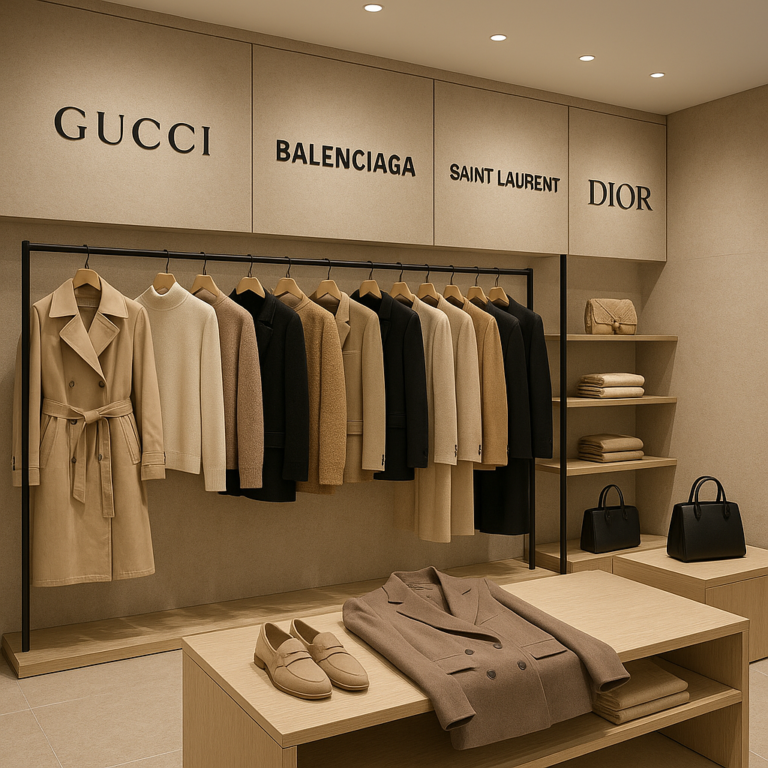
- Gucci: The double G, representing founder Guccio Gucci.
- Chanel: Interlocking Cs designed by Coco herself.
- Fendi: The “Zucca” inverted Fs.
- Hermès: The Duc carriage and horse, nodding to their saddlery roots.
- Versace: The Medusa head—designed to make people fall in love with the brand forever.
- Burberry: The Equestrian Knight (recently revived!) and the iconic check.
- Prada: The Savoy coat of arms triangle.
- Dolce & Gabbana: The bold, authoritative “DG.”
- Saint Laurent: The vertical “YSL” monogram—a vertical feat of typography.
- Givenchy: The four “G”s forming a square.
- Balenciaga: The modern, minimalist sans-serif wordmark.
- Dior: The “CD” monogram and the elegant serif wordmark.
- Valentino: The “V” logo surrounded by an ellipse.
- Armani: The stylized eagle (GA), symbolizing quality and supremacy.
👉 Shop Luxury Brands on:
- Gucci: Amazon | Gucci Official Website
- Prada: Amazon | Prada Official Website
👟 Sportswear Giants: Performance Symbols and Speed Marks
- Nike: The “Swoosh,” representing the wing of the Greek Goddess Nike.
- Adidas: The “Three Stripes” and the “Trefoil.”
- Puma: The leaping cat, symbolizing agility.
- Under Armour: The interlocking “U” and “A.”
- Reebok: The “Delta” and the classic “Vector.”
- New Balance: The “NB” with speed lines.
- Asics: The “A” spiral, representing “A Sound Mind in a Sound Body.”
- Champion: The iconic “C” patch found on every 90s sweatshirt.
- Converse: The “Chuck Taylor” star.
- Vans: The “Off the Wall” skateboard logo.
- Lululemon: The stylized “A” (which actually stands for “Athletically Hip”).
- Fila: The “F-Box” with its distinct red and blue.
- Jordan: The “Jumpman”—perhaps the most famous silhouette in history.
- Kappa: The “Omini” logo featuring a man and woman sitting back-to-back.
- Umbro: The double diamond.
👉 Shop Sportswear on:
- Nike: Amazon | Walmart | Nike Official Website
- Adidas: Amazon | Adidas Official Website
skateboard Streetwear Rebels: Bold Typography and Counter-Culture Graphics
- Supreme: The red box logo (inspired by artist Barbara Kruger).
- Off-White: The diagonal stripes and “X” arrows.
- Stüssy: The “Shawn Stüssy” hand-drawn signature.
- A Bathing Ape (BAPE): The Ape Head.
- Palace: The “Tri-Ferg” triangle.
- Stone Island: The compass rose patch.
- Fear of God: Minimalist, high-fashion typography.
- Kith: Clean, modern wordmarks.
- AUVRA: As noted on Pinterest, a rising star in streetwear graphics.
- Rhude: Blending 90s art with luxury aesthetics.
🌲 Outdoor & Performance: Nature-Inspired Brand Marks
- The North Face: Inspired by the Half Dome in Yosemite.
- Patagonia: The Fitz Roy mountain skyline.
- Columbia: The “Bugaboo” textile weave pattern.
- Arc’teryx: The Archaeopteryx (the first bird) skeleton.
- Timberland: The sturdy branch-laden tree.
- Helly Hansen: The “HH” bold block.
🛍️ Retail & Fast Fashion: Minimalist Wordmarks for Global Appeal
- Zara: The overlapping, tightly-spaced serif.
- H&M: The energetic, hand-written red script.
- Uniqlo: The Japanese katakana and English red squares.
- Gap: The classic blue box (and the brief, failed redesign saga!).
- Levi’s: The “Batwing” logo.
- Calvin Klein: The “ck” monogram.
- Ralph Lauren: The Polo Player.
- Lacoste: The Crocodile.
- Tommy Hilfiger: The red, white, and blue nautical flag.
🎨 Decoding Design: Monograms, Wordmarks, and Pictorial Logos
Not all logos are created equal. When we consult on Affordable Fashion Brands, we look at three main design pillars:
- Monograms (Lettermarks): These are perfect for brands with long names. Think IBM or YSL. In fashion, they scream “heritage.”
- Wordmarks (Logotypes): Focuses entirely on typography. Supreme and Prada use this to build a name-first identity.
- Pictorial Marks (Logo Symbols): An icon or graphic-based design. The Apple logo or the Twitter bird (RIP) are non-fashion examples, but in our world, the Lacoste croc is the king.
Stylist Tip: If you’re starting a brand, tools like Placeit offer a great jumping-off point with templates ranging from “Urban Graffiti” to “High-End Medusa” graphics. 🎨
🌈 Color Theory in Apparel: What Your Favorite Brand’s Palette Secretly Tells You
Color isn’t just an aesthetic choice; it’s a psychological trigger. We’ve analyzed the most common palettes in our Brand Collaboration Highlights:
- Black: Power, elegance, and mystery. Used by Chanel, Prada, and Nike. It’s the “little black dress” of logo colors. 🖤
- Red: Passion, energy, and excitement. Supreme, H&M, and Levi’s use red to grab your attention and never let go. ❤️
- Blue: Trust, reliability, and calm. Gap and Tiffany & Co. use blue to build a sense of lasting quality. 💙
- Gold: Luxury, wealth, and excess. Versace and Rolex wouldn’t be the same without it. 👑
🕵️ ♂️ Hidden Meanings: Secret Messages Tucked Inside Famous Fashion Logos
We love a good fashion mystery! Did you know some logos have “Easter eggs”?
- The North Face: The logo is a stylized version of the Half Dome rock formation in Yosemite National Park, but it’s also meant to look like a mountain peak.
- Levi’s: Look closely at the bottom of the “Batwing” logo. It mimics the shape of the pockets on a pair of Levi’s jeans! 👖
- Adidas: The three stripes on the “Mountain” logo represent the challenges to be faced and the goals to be achieved.
- Quiksilver: The logo is a stylized version of “The Great Wave off Kanagawa,” a famous Japanese woodblock print.
📐 The Anatomy of a Great Logo: Essential Elements for New Designers
If you’re looking to create the next Nike or Gucci, you need to follow these golden rules we’ve gathered from years of industry insight:
- Scalability: Can you see the logo clearly on a tiny shirt button and a massive billboard?
- Simplicity: Does it have too many “moving parts”? If it’s too busy, it won’t be memorable. ❌
- Timelessness: Will this look “cringe” in five years? Avoid overly trendy fonts.
- Versatility: Does it look good in black and white? A great logo doesn’t rely solely on color to work.
- Relevance: Does the logo match the “vibe” of the clothes? You wouldn’t use a graffiti font for a tuxedo rental shop (unless it’s very avant-garde).
🚀 The Future of Fashion Branding: Digital-First Identities and Sustainability Symbols
As we move into a more eco-conscious era, logos are changing. We are seeing a rise in “Sustainability Marks”—symbols that certify a brand’s commitment to the planet. Brands are also “de-branding,” moving toward ultra-minimalist logos that look better on smartphone screens.
Think of the recent “Blandification” trend where brands like Burberry, Berluti, and Balmain all swapped their unique serif fonts for very similar-looking sans-serifs. Is it boring? Maybe. Is it optimized for Instagram? Absolutely. 📱
🖼️ Curated Style Boards: Visual Inspiration for Your Brand Identity
Looking for a specific aesthetic? Based on our research into Pinterest trends, here are the “moods” dominating the industry right now:
- The “Old Money” Aesthetic: Crests, serif fonts, and muted tones (Navy, Forest Green, Cream).
- The “Cyber-Y2K” Look: Metallic finishes, liquid fonts, and neon accents.
- The “Quiet Luxury” Vibe: No visible logo at all—or a logo so small you need a magnifying glass to see it. (Think The Row or Loro Piana).
But wait—if the logo is disappearing in “Quiet Luxury,” does that mean the era of the iconic logo is over? Or is the “no-logo” look just the ultimate logo in itself? We’ll explore the answer to that paradox in our final thoughts. 🧐
✨ Conclusion

So, we’ve journeyed from the discreet silk labels of 19th-century tailors to the neon-drenched, digital-first identities of today’s streetwear rebels. We asked a burning question earlier: If the “Quiet Luxury” trend is all about hiding the logo, does that mean the era of the iconic logo is over?
The answer is a resounding NO.
The “no-logo” look isn’t the death of branding; it’s the ultimate flex. When you wear a The Row or a Loro Piana piece with no visible mark, you are signaling that you know the brand so well that you don’t need the logo to tell you. It’s the difference between shouting your name and whispering it to someone who already knows you. The logo hasn’t disappeared; it has simply evolved from a billboard on your chest to a subtle whisper in the fabric’s weave.
Whether you are a fashion enthusiast looking to decode the symbols on your wardrobe or an aspiring designer ready to launch your own line, remember this: A great logo is a promise kept. It promises quality, identity, and a story that connects you to a tribe.
Our Final Verdict:
- Positives: Iconic logos like the Nike Swoosh and Louis Vuitton Monogram offer instant recognition, timeless style, and a sense of belonging. They are versatile, scalable, and deeply rooted in psychological triggers that drive loyalty.
- Negatives: The rise of “logomania” can sometimes lead to tacky over-branding, and the trend of “quiet luxury” might alienate those who rely on visible status symbols. Additionally, the market is flooded with counterfeits that dilute the integrity of these symbols.
- Confident Recommendation: Don’t chase the trend of the moment. Whether you choose a bold Supreme box logo or a subtle Gucci interlocking G, choose a brand whose values align with your personal narrative. If you are creating your own brand, prioritize simplicity and scalability over complex, trendy graphics. A logo that works in black and white on a tiny tag will outlast any neon gradient.
Ready to craft your own visual identity? Don’t just dream it—design it.
🔗 Recommended Links
Whether you are hunting for vintage classics, modern staples, or tools to create your own brand identity, here are our top picks:
👉 Shop Iconic Brands
- Nike: Amazon | Nike Official Website
- Adidas: Amazon | Adidas Official Website
- Supreme: StockX | Supreme Official Website
- Levi’s: Amazon | Levi’s Official Website
- Patagonia: Amazon | Patagonia Official Website
- Ralph Lauren: Amazon | Ralph Lauren Official Website
Design Your Own Logo
- Create Custom Clothing Logos: Placeit Logo Maker – The ultimate tool for non-designers to generate professional, trendsetting logos in minutes.
Must-Read Books on Fashion Branding
- “The Brand Gap” by Marty Neumeier: Amazon – Essential reading for understanding the psychology behind brand identity.
- “Logo Design Love” by David Airey: Amazon – A practical guide to creating memorable logos.
- “Steal Like an Artist” by Austin Kleon: Amazon – Inspiration for finding your unique creative voice.
❓ FAQ: Everything You Ever Wanted to Know About Fashion Logos

What clothing brand logos are trending among young adults?
Young adults (Gen Z and younger Millennials) are currently oscillating between two extremes. On one hand, there is a massive resurgence of 90s and Y2K nostalgia, making logos like Champion, Fila, and Tommy Hilfiger incredibly popular. On the other hand, the “Quiet Luxury” movement has made minimalist, logo-less, or micro-logo designs from brands like The Row, Bottega Veneta, and Jacquemus highly desirable. The trend is less about the logo itself and more about how it’s worn—either as a bold statement or a subtle nod.
Read more about “Which Clothing Brands Top Customer Loyalty in 2026? 🔥”
How do clothing brands design their logos for maximum impact?
Brands use a combination of psychology, color theory, and simplicity. They aim for a design that is:
- Memorable: Can it be drawn from memory?
- Scalable: Does it look good on a hat and a billboard?
- Timeless: Will it still look cool in 10 years?
- Distinctive: Does it stand out from competitors?
Tools like Placeit help brands visualize these elements quickly, but the core strategy relies on understanding the target audience’s emotional triggers.
What is the history behind famous clothing brand logos?
Many logos have deep historical roots. Lacoste (1933) was the first to put a logo on the outside of a shirt, inspired by tennis player René Lacoste’s nickname “The Crocodile.” Nike’s Swoosh (1971) was designed by a student for $35 to represent the wing of the Greek goddess of victory. Adidas evolved from the “Three Stripes” (originally a functional design by a shoemaker) to the “Trefoil” (1971) and the “Mountain” (1990s), reflecting the brand’s expansion into different sports categories.
How can I identify clothing brands by their logos?
The best way is to study the anatomy of the logo:
- Monograms: Look for interlocking letters (e.g., LV, GG, YSL).
- Pictorials: Look for animals (crocodile, horse, cat) or objects (mountain, tree, carriage).
- Typography: Note the font style (serif vs. sans-serif) and unique letter spacing (e.g., Zara‘s overlapping letters).
- Color: Specific color combinations are often trademarked (e.g., Tiffany Blue, Hermès Orange).
Which clothing brands have the most iconic logos?
The “Holy Grail” of logos includes:
- Nike: The Swoosh.
- Adidas: The Three Stripes/Trefoil.
- Louis Vuitton: The LV Monogram.
- Chanel: The Interlocking C.
- Ralph Lauren: The Polo Player.
- Lacoste: The Crocodile.
- Supreme: The Red Box.
These logos are recognized globally, often without the brand name even being present.
How do clothing brand logos influence fashion trends?
Logos act as cultural signifiers. When a logo becomes associated with a specific subculture (e.g., Supreme with skate culture, Gucci with the “old money” aesthetic), wearing that logo signals membership in that group. This drives trends as consumers seek to emulate the lifestyle associated with the brand. Conversely, when a logo becomes “too common,” it can fall out of favor, leading to the rise of “quiet luxury.”
Read more about “Top 30 Clothing Brands You Need to Know in 2026 👗”
What are the most popular clothing brand logos?
Popularity fluctuates, but the most consistently popular logos across decades include Nike, Adidas, Champion, Levi’s, and Polo Ralph Lauren. In the luxury sector, Louis Vuitton, Gucci, and Chanel remain top-tier. In streetwear, Supreme, Off-White, and Stüssy dominate.
What is the relationship between a clothing brand’s logo and its target audience?
The logo is a filter. It attracts the right audience and repels the wrong one. A Harley Davidson logo attracts motorcycle enthusiasts and those who value rugged individualism, while a Gucci logo attracts those who value heritage and opulence. The logo communicates the brand’s values, price point, and lifestyle, ensuring that the wearer feels a sense of belonging to the brand’s “tribe.”
Read more about “12 Game-Changing Fashion Brand Market Research Tips (2026) 🔍”
How can a clothing brand logo contribute to brand recognition?
A consistent logo creates visual memory. When a consumer sees the Swoosh, they instantly think of “athleticism” and “performance.” This association is built over time through consistent marketing and product quality. A strong logo reduces the cognitive load for the consumer, making the brand the “safe” or “obvious” choice in a crowded market.
Read more about “8 Longest Fashion Brand Names: Unveiling the Giants! ✨ (2026)”
What are some examples of minimalist clothing brand logos?
Minimalist logos focus on clean lines and typography. Examples include:
- Acne Studios: Simple, bold sans-serif text.
- The Row: Often no logo, or extremely subtle text.
- COS: Clean, geometric typography.
- Uniqlo: The red square with simple white text.
- Balenciaga: The modern, stark sans-serif wordmark.
How do clothing brands update their logos over time?
Brands update logos to stay relevant, a process called rebranding. This often involves:
- Simplification: Removing gradients or complex details (e.g., Burberry‘s recent shift to a sans-serif font).
- Modernization: Updating fonts to fit digital screens.
- Nostalgia: Reverting to older versions of the logo (e.g., Fila or Champion bringing back vintage styles).
- Expansion: Adapting the logo for new product lines (e.g., Adidas using different logos for Originals vs. Performance).
Read more about “15 Clothing Brands with Limited Edition Collections You Can’t Miss in 2026 ✨”
How important is color choice in clothing brand logos?
Color is critical. It accounts for up to 80% of brand recognition.
- Red: Energy, passion (Supreme, Levi’s).
- Blue: Trust, reliability (Gap, Tommy Hilfiger).
- Black: Luxury, power (Chanel, Prada).
- Green: Nature, sustainability (Patagonia, Whole Foods).
Choosing the wrong color can send the wrong message, confusing the target audience.
What are some common design elements used in clothing brand logos?
Common elements include:
- Monograms: Interlocking letters.
- Animals: Symbolizing traits (speed, strength, elegance).
- Geometric Shapes: Circles, squares, triangles for stability or dynamism.
- Typography: Serif for tradition, Sans-serif for modernity.
- Nature Elements: Mountains, trees, waves (The North Face, Patagonia).
How do clothing brand logos influence consumer perception?
Logos create a halo effect. A high-end logo can make a consumer perceive the quality of the garment as higher, even if the material is identical to a generic brand. Conversely, a poorly designed or “tacky” logo can make a high-quality garment seem cheap. The logo sets the expectation for the entire brand experience.
Read more about “How Clothing Brands Shape Your Style & Confidence in 2025 ✨”
What makes a clothing brand logo iconic?
An iconic logo is simple, timeless, and emotionally resonant. It transcends language barriers and cultural shifts. It tells a story in a single glance. Think of the Nike Swoosh—it doesn’t need words to say “Just Do It.” It’s a symbol of movement and achievement that has become part of the global visual language.
Read more about “What Are the Top 5 Apparel Clothing Lines? Discover the Leaders of 2026 👗”
What is the best brand logo?
There is no single “best” logo, as it depends on the brand’s goals. However, in terms of recognition and longevity, the Nike Swoosh and the Louis Vuitton Monogram are often cited as the gold standards. They have successfully adapted to changing times while maintaining their core identity.
Read more about “The 40 Most Expensive Clothing Brands You’ve Never Heard Of (2026) 💸”
What clothing brand has a 3 line logo?
The brand with the famous “3 line” logo is Adidas. The three stripes are their most recognizable element, originally designed to provide stability and support in footwear, but now a symbol of the brand’s heritage and performance.
What type of logo is best for a clothing brand?
The “best” type depends on the brand’s identity:
- Monograms are best for luxury and heritage brands.
- Wordmarks are best for new brands establishing their name.
- Pictorial marks are best for brands with a strong visual story (e.g., animals, nature).
- Abstract marks are best for modern, innovative brands.
Ultimately, the best logo is one that is consistent, scalable, and authentic to the brand’s values.
Read more about “What Are the 30 Best Clothing Brands to Know in 2026? 👗”
How do I find a clothing brand by a logo?
If you see a logo you don’t recognize:
- Reverse Image Search: Use Google Lens or TinEye to upload a photo of the logo.
- Describe the Elements: Search for “clothing brand with [animal] logo” or “clothing brand with [color] box logo.”
- Check the Tag: Look inside the garment for a label that might have the brand name or website.
- Use Community Forums: Post the image on Reddit (r/whatisthisthing) or fashion forums for crowd-sourced identification.
📚 Reference Links
- Psychology of Color in Marketing: Psychology Today
- The History of the Nike Swoosh: Nike News
- Louis Vuitton Monogram History: Louis Vuitton Official
- Adidas Logo Evolution: Adidas Group
- Lacoste Heritage: Lacoste Official
- Placeit Logo Maker: Placeit Clothing Logo Maker
- Pinterest Inspiration: Clothing Brand Logos on Pinterest
- Fashion Branding Trends: Vogue Business
- Brand Identity Design: Smashing Magazine