Support our educational content for free when you purchase through links on our site. Learn more
35+ Famous Clothing Brand Logos: The Ultimate 2026 Guide 🧵

The most iconic famous clothing brand logos aren’t just pretty pictures; they are silent status symbols that can instantly elevate an outfit or signal a specific subculture. From the understated elegance of a Chanel interlock to the rebellious roar of a Supreme box, understanding these emblems is your key to decoding fashion history and spotting quality at a glance.
Did you know the legendary Nike Swosh was designed for a mere $35, yet today represents a brand worth over $10 billion? It proves that a great logo doesn’t need to be complex to be powerful. We’ve scoured the runways, the streets, and the archives to bring you a definitive list of 35+ famous clothing brand logos that define our era.
Whether you’re a vintage hunter trying to spot a fake Gucci or a streetwear enthusiast hunting for the next big drop, this guide breaks down the stories, symbols, and secrets behind the world’s most recognizable marks.
Key Takeaways
- Simplicity Sells: The most enduring famous clothing brand logos often rely on minimalism and perfect symmetry rather than intricate details.
- History Matters: Many iconic marks, like the Louis Vuiton monogram, were originally created as anti-counterfeiting measures that accidentally became status symbols.
- Color Psychology: Brands strategically use color (like Hermès orange or Supreme red) to trigger specific emotional responses and brand recognition.
- Authenticity Check: Knowing the specific font weights, spacing, and stitching patterns of these logos is your best defense against counterfeit goods.
- Evolution is Key: Even heritage houses like Burberry and Fendi have modernized their logos to stay relevant in the digital age.
Table of Contents
-
🏆 The Titans of the Runway: Luxury and High-End Fashion Logos
-
30. Tommy Hilfiger: The Flag That Wears Red, White, and Blue
⚡️ Quick Tips and Facts
Before we dive into the deep end of the fashion pool, let’s splash around with some essential truths about the world of brand logos. You might think a logo is just a pretty picture stitched onto a t-shirt, but oh, my friend, it’s so much more. It’s a silent salesman, a status symbol, and sometimes, a historical artifact.
Here is the lowdown on what makes these emblems tick:
- The $35 Million Dollar Mistake: Did you know the most famous logo in history, the Nike Swosh, was designed by a graphic design student named Carolyn Davidson for a mere $35 in 1971? Phil Knight, Nike’s co-founder, famously admitted, “I don’t love it, but it will grow on me.” Spoiler alert: It grew on him (and the world) big time. Source: Nike History
- The Monogram Mania: Louis Vuiton created their iconic “LV” monogram in 1896 specifically to stop people from copying their designs. Ironically, it became the most counterfeited logo in history. Source: Business Insider
- Scalability is King: A great fashion logo must work on a 16px hangtag and a 10-foot billboard. If it looks like a blurry mess on your phone screen, it’s not ready for the runway.
- Color Psychology: Supreme’s red box isn’t just bold; it’s a psychological trigger for urgency and youth culture, inspired by artist Barbara Kruger. Meanwhile, Hermès sticks to orange because it represents energy and creativity, standing out against the sea of black and gold luxury brands.
- The “Quiet Luxury” Shift: In the last decade, we’ve seen a massive shift from loud, screaming logos to minimalist typography. Brands like Balenciaga and Burberry ditched their ornate scripts for clean, all-caps sans-serifs. Why? Because sometimes, the most expensive thing you can wear is a logo that barely says anything.
For a deeper dive into how these symbols shape our perception of value, check out our comprehensive guide on clothing brands logos.
📜 The Evolution of Fashion Brand Identity: A Brief History

Let’s take a time machine back to the days when “branding” meant nothing more than a blacksmith’s mark on a horseshoe. Fast forward to the 19th century, and the fashion world was a chaotic mess of unbranded goods. How did we get from there to the iconic logos we obsess over today?
The Birth of the Designer Label
In the mid-180s, Charles Frederick Worth changed the game. He was the first to sew his label into the garments he created, effectively turning clothes into art. Before Worth, clothes were made by tailors who remained anonymous. Worth made the designer the star. This was the genesis of the modern fashion logo.
The Monogram Era (Late 19th – Early 20th Century)
As travel became popular among the elite, luggage needed to be identifiable. Enter Louis Vuiton and Gucci. They realized that a repeating pattern of initials wasn’t just decorative; it was a security feature and a status signal.
- Louis Vuiton (1896): Georges Vuiton created the “LV” monogram to prevent counterfeiting.
- Gucci (193): The double-G logo was born from the founder’s initials, Guccio Gucci.
The Logo Explosion (1980s – 20s)
The 80s were the era of logomania. If you weren’t wearing a giant Ralph Lauren polo player or a Versace Medusa, were you even trying? This was the “Golden Age” of branding, where the logo was the product.
The Minimalist Revolution (2010s – Present)
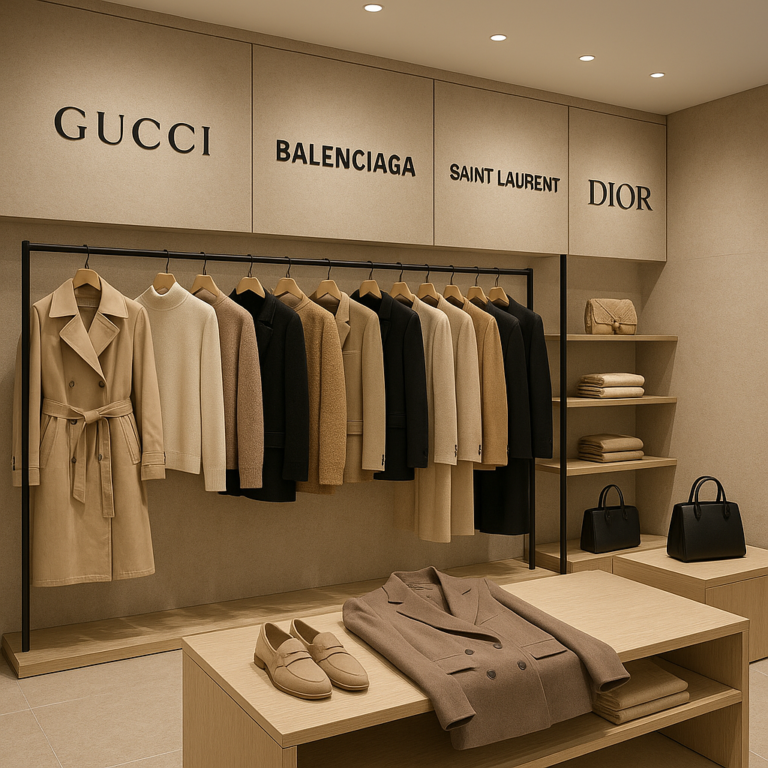
Fast forward today. The pendulum has swung back. Balenciaga, Saint Laurent, and Celine have stripped away the ornamentation. The logo is now often just the brand name in a stark, clean font. It’s a statement of confidence: “We don’t need a fancy symbol; our name is enough.”
Fun Fact: The Chanel interlocking C’s were created around 1921. It is one of the longest-running graphic identities in commercial history, proving that simplicity truly is the ultimate sophistication. Source: Vogue Business
🏆 The Titans of the Runway: Luxury and High-End Fashion Logos
When it comes to luxury, a logo isn’t just a mark; it’s a passport to an exclusive club. These brands have mastered the art of visual storytelling. Let’s break down the heavy hitters.
1. Chanel: The Timeless Interlocking C’s
- Design: Two interlocking, back-to-back “C”s.
- Symbolism: Coco Chanel created this in 1921. Some say it represents her initials; others claim it mirrors the stained glass windows of the Château de Crémat where she spent time.
- Why it Works: It’s perfectly symetrical, elegant, and works in black, white, or gold. It screams timeless elegance.
- Stylist Tip: If you see a Chanel bag with the C’s facing the same way, run. It’s a fake. The interlocking must be back-to-back.
2. Gucci: Double Gs and Heritage Redefined
- Design: Two interlocking “G”s facing opposite directions.
- Symbolism: Created in the 1960s by Aldo Gucci, the son of the founder. The design was inspired by the stirups of a horse, noding to the brand’s equestrian roots.
- Evolution: Under Alessandro Michele, the logo became more ornate, often paired with floral motifs, before returning to a cleaner, retro look under Sabato De Sarno.
- Stylist Tip: The GG Supreme canvas is the most recognizable pattern in fashion history. It’s bold, but pair it with solid neutrals to let the logo breathe.
3. Louis Vuiton: The Monogram That Conquered the World
- Design: Interlocking “L” and “V” surrounded by quatrefoils and flowers.
- History: Designed by Georges Vuiton in 1896 to honor his father and prevent counterfeits.
- Impact: It is the most counterfeited logo in history. The sheer ubiquity of the LV monogram makes it a global symbol of wealth.
- Stylist Tip: Don’t be afraid to mix LV with other luxury brands. The monogram is so strong it acts as a neutral.
4. Hermès: The Orange Box and the Silent Horse
- Design: A horse-drawn carriage with a child sitting in it, often accompanied by the word “Hermès” in a serif font.
- Symbolism: The carriage represents the brand’s origins in harness making. The orange box is just as iconic as the logo itself.
- Uniqueness: Unlike other luxury brands, Hermès rarely uses its logo on the outside of its most coveted bags (like the Birkin). The silence is the luxury.
- Stylist Tip: If you own an Hermès piece, you don’t need to show the logo. The quality speaks for itself.
5. Prada: Minimalism Mets Intellectual Chic
- Design: A simple black triangle with “Prada Milano” and “Fondazione Prada” inscribed.
- Evolution: Originally a leather goods shop, Prada’s logo has remained remarkably consistent, focusing on understated luxury.
- Why it Works: It doesn’t scream; it whispers. It appeals to the intellectual elite who value design over flash.
6. Versace: The Medusa That Stares Back
- Design: The head of Medusa from Greek mythology, framed by Greek keys.
- Symbolism: Gianni Versace chose Medusa because she made people fall in love with her, and they couldn’t look away. It represents beauty, power, and seduction.
- Stylist Tip: The Medusa is a bold statement. Wear it when you want to command the room.
7. Burberry: The Check Pattern as a Global Icon
- Design: The “Equestrian Knight” logo and the iconic Nova Check (beige, black, red, white).
- Evolution: In 2018, Riccardo Tisci and Peter Saville stripped the logo down to a clean, all-caps sans-serif “BURBERRY,” moving away from the ornate script.
- Stylist Tip: The check is polarizing. If you wear it, keep the rest of your outfit simple to avoid looking like a walking billboard.
8. Fendi: The Double F and the Fur Legacy
- Design: Two interlocking “F”s, one upright and one inverted.
- Symbolism: Created by Karl Lagerfeld in 1965. The “F” stands for “Fun Fur” and the founders, Edoardo and Adele Fendi.
- Stylist Tip: The Baguette bag often features this logo. It’s a playful yet sophisticated choice.
9. Dior: The Elegant Serif of a French House
- Design: A clean, serif wordmark.
- Evolution: Recently, Dior has experimented with a more modern, slightly condensed font, but the classic serif remains the heart of the brand.
- Stylist Tip: The Saddle Bag often features the logo in a subtle, embossed way. It’s a nod to heritage without being loud.
10. Saint Laurent: The YSL Monogram’s Sharp Edge
- Design: Interlocking “Y”, “S”, and “L”.
- History: Designed by Adolphe Mouron Cassandre in 1961. It was one of the first logos to be used as a fashion pattern.
- Stylist Tip: The YSL logo is sharp and edgy. Perfect for night-out looks.
| Brand | Logo Type | Key Symbol | Year Created | Vibe |
|---|---|---|---|---|
| Chanel | Monogram | Interlocking C’s | ~1921 | Timeless, Elegant |
| Gucci | Monogram | Double G | 193 | Heritage, Bold |
| LV | Monogram | LV + Flowers | 1896 | Global, Status |
| Hermès | Symbol | Horse & Cariage | 1837 | Quiet, Luxe |
| Versace | Symbol | Medusa | 1978 | Seductive, Bold |
| Burberry | Pattern | Nova Check | 1924 | Classic, British |
| Fendi | Monogram | Double F | 1965 | Playful, Chic |
| Dior | Wordmark | Serif Text | 1946 | Elegant, French |
| YSL | Monogram | YSL | 1961 | Edgy, Modern |
👟 Streetwear Giants and Urban Culture Symbols
If luxury is about heritage, streetwear is about hype, rebellion, and community. These logos aren’t just marks; they are tattos of identity for a generation.
1. Supreme: The Red Box That Started a Revolution
- Design: A simple red rectangle with “Supreme” in white Futura Bold Italic.
- Origin: Inspired by artist Barbara Kruger’s “I Shop Therefore I Am.”
- Cultural Impact: It turned a simple box logo into the most coveted item in streetwear. The drop culture model was perfected here.
- Stylist Tip: Supreme is best worn as a statement piece. One item is enough; don’t overdo it.
12. BAPE: The Camo and the Shark That Roared
- Design: The “A Bathing Ape” logo and the iconic Shark Hoodie with the full-face camo print.
- Origin: Founded by Nigo in Tokyo in 193.
- Symbolism: The shark represents the “ape” in the water, ready to strike. It’s a symbol of urban cool.
- Stylist Tip: The camo is loud. Pair it with solid black or white to let the pattern pop.
13. Off-White: The Quotation Marks and Industrial Aesthetic
- Design: “OFF-WHITE” with quotation marks and the diagonal stripes.
- Origin: Founded by Virgil Abloh in 2013.
- Concept: Abloh believed in “3% theory”—changing a classic design by 3% to make it new. The quotation marks suggest irony and questioning.
- Stylist Tip: The diagonal stripes are instantly recognizable. They add an industrial edge to any outfit.
14. Stüssy: The Scribble That Defined a Generation
- Design: Shawn Stüssy’s handwritten signature.
- Origin: Started as a surf brand in the 80s, evolved into a streetwear staple.
- Why it Works: It feels authentic and personal. It’s not a corporate logo; it’s a signature.
- Stylist Tip: Stüssy is the king of “cool without trying.” Perfect for casual, everyday wear.
15. Palace: The Tri-Ferg and Skate Heritage
- Design: A triangular logo with “Palace” inside.
- Origin: Founded in London in 209.
- Symbolism: The triangle is a nod to skate culture and British humor.
- Stylist Tip: Palace is often paired with oversized silhouettes. It’s a true skate brand at heart.
16. Jordan Brand: The Jumpman That Flew High
- Design: Michael Jordan in mid-air, dunking.
- Origin: Created in 198 from a photo of Jordan.
- Impact: It’s the most recognizable sports logo in the world. It represents excellence and flight.
- Stylist Tip: The Jumpman is a classic. It works with everything from jogers to suits.
17. Yeezy: The Minimalist Text That Shook the Industry
- Design: Simple, bold text “YEEZY” or “YZY”.
- Origin: Kanye West’s collaboration with Adidas.
- Concept: Minimalism taken to the extreme. The logo is often hidden or very subtle.
- Stylist Tip: Yeezy is about the silhouette more than the logo. The shoes speak louder than the text.
18. Fear of God: The Script That Elevated Casual Wear
- Design: A cursive, handwritten script.
- Origin: Founded by Jerry Lorenzo.
- Concept: Blending luxury with streetwear. The script adds a touch of personal touch to the rugged aesthetic.
- Stylist Tip: Fear of God is perfect for the “elevated casual” look. Pair with high-quality basics.
🏃 ♂️ Sportswear Icons: From the Track to the Streets
Sportswear logos are unique because they bridge the gap between performance and fashion. They are worn by athletes and celebrities alike.
19. Nike: The Swosh That Says “Just Do It”
- Design: A simple checkmark (Swosh).
- History: Designed by Carolyn Davidson for $35.
- Symbolism: Represents the wing of the Greek goddess Nike, symbolizing speed and movement.
- Stylist Tip: The Swosh is the ultimate neutral. It goes with everything.
20. Adidas: The Three Stripes and the Trefoil
- Design: Three stripes (performance) and the Trefoil (originals).
- Symbolism: The three stripes represent the mountain (challenges) and the three parts of the world.
- Evolution: The Trefoil is now the symbol of the “Originals” line, representing heritage.
- Stylist Tip: Mix the Trefoil with modern streetwear for a retro vibe.
21. Puma: The Leaping Cat with Global Reach
- Design: A leaping puma.
- Symbolism: Represents speed, power, and agility.
- Stylist Tip: Puma is great for a sporty, athletic look. The logo is subtle but recognizable.
2. Under Armour: The Interlocking UA Power Move
- Design: Interlocking “U” and “A”.
- Symbolism: Represents the strength and unity of the brand.
- Stylist Tip: Under Armour is often associated with performance. Great for gym wear.
23. New Balance: The “N” That Stands for Comfort
- Design: A bold “N”.
- Symbolism: Represents quality and comfort.
- Stylist Tip: New Balance has become a streetwear staple. The “N” is a classic.
24. Rebok: The Vector and the Delta Shift
- Design: The Vector logo (three lines) and the Delta symbol.
- Symbolism: The Delta represents change and evolution.
- Stylist Tip: Rebok is making a comeback with retro styles. The Vector is a cool, geometric logo.
25. Lulemon: The Om Symbol of Yoga Culture
- Design: A stylized “A” that looks like the Om symbol.
- Symbolism: Represents mindfulness and balance.
- Stylist Tip: Lulemon is the go-to for athleisure. The logo is subtle and elegant.
🛍️ High Street Heroes and Mass Market Favorites
These brands make fashion accessible to everyone. Their logos are designed to be instantly recognizable on the high street.
26. Zara: The Sharp Typography of Fast Fashion
- Design: A bold, serif wordmark with overlapping letters.
- Evolution: Recently changed to a more spaced-out, modern font.
- Why it Works: It’s clean, modern, and reflects the brand’s fast-paced nature.
- Stylist Tip: Zara is great for trend-driven pieces. The logo is often subtle.
27. H&M: The Blue and Yellow Simplicity
- Design: “H&M” in a simple, bold font.
- Origin: Stands for Hennes & Mauritz.
- Why it Works: It’s simple, affordable, and recognizable.
- Stylist Tip: H&M is perfect for basics. The logo is often hidden on tags.
28. Uniqlo: The Red Square of Everyday Essentials
- Design: A red square with “UNIQLO” in white.
- Symbolism: The red square represents energy and passion.
- Why it Works: It’s simple and memorable.
- Stylist Tip: Uniqlo is the king of basics. The logo is often on the tag.
29. Levi’s: The Batwing and the Red Tab Legacy
- Design: The “Batwing” logo and the iconic red tab.
- History: The red tab was introduced in 1936.
- Symbolism: Represents durability and American heritage.
- Stylist Tip: The red tab is a subtle detail that adds authenticity.
30. Tommy Hilfiger: The Flag That Wears Red, White, and Blue
- Design: A red, white, and blue flag.
- Symbolism: Represents American preppy style.
- Stylist Tip: Tommy is great for a classic, preppy look. The flag is a bold statement.
31. Ralph Lauren: The Polo Player on a Horse
- Design: A polo player on a horse.
- Symbolism: Represents luxury, sport, and American heritage.
- Stylist Tip: The polo player is a classic. It’s a subtle way to show off your style.
32. Gap: The Blue Box That Changed Denim
- Design: A blue box with “GAP” in white.
- History: The blue box was introduced in 1969.
- Symbolism: Represents simplicity and accessibility.
- Stylist Tip: Gap is great for basics. The logo is often subtle.
3. Forever 21: The Bold Script of Teen Trends
- Design: A bold, cursive script.
- Symbolism: Represents youth and trends.
- Stylist Tip: Forever 21 is great for trendy, affordable pieces. The logo is often bold.
🎨 Decoding the Design: What Makes a Logo Stick?
Why do some logos become icons while others fade into obscurity? It’s not just luck; it’s science.
The Psychology of Color in Fashion Branding
- Red: Energy, passion, urgency (Supreme, Levi’s).
- Black: Luxury, sophistication, power (Chanel, YSL).
- Blue: Trust, stability, calm (H&M, Gap).
- Gold: Wealth, exclusivity, quality (Gucci, Louis Vuiton).
- Orange: Creativity, energy, warmth (Hermès).
Typography Trends: Serif vs. Sans-Serif in Luxury
- Serif: Traditional, elegant, heritage (Dior, Gucci).
- Sans-Serif: Modern, clean, minimal (Balenciaga, Burberry).
- Script: Personal, handcrafted, unique (Stüssy, Christian Louboutin).
Why Monograms Rule the Runway
Monograms are repeatable patterns that create a sense of continuity and heritage. They are also great for branding on small items like bags and shoes.
The Rise of Minimalism in Modern Fashion Logos
In the 2010s, many luxury brands shifted to minimalist logos. This reflects a desire for understated luxury and a move away from the “logomania” of the 80s and 90s.
🔍 How to Spot a Fake: Authenticity Checks for Famous Logos
With the rise of counterfeit goods, it’s crucial to know how to spot a fake. Here are some tips:
Common Mistakes in Counterfeit Logos
- Spacing: Fake logos often have incorrect spacing between letters.
- Font: The font might be slightly off or the wrong weight.
- Color: The color might be slightly different from the original.
- Stitching: Poor stitching is a common sign of a fake.
Where to Verify Your Designer Gear
- Official Brand Websites: Check the brand’s official site for logo details.
- Authentication Services: Use services like Entrupy or Real Authentication.
- Retailers: Buy from authorized retailers to ensure authenticity.
🚀 Future Trends: How Digital Fashion is Changing Logos
The future of fashion logos is digital. With the rise of NFTs and virtual fashion, logos are becoming more than just physical marks.
- Dynamic Logos: Logos that change based on the environment or the wearer.
- Augmented Reality (AR): Logos that come to life through AR.
- Virtual Fashion: Logos that exist only in the digital realm.
💡 Quick Tips and Facts Recap
Let’s recap the key takeaways:
- Simplicity is key to a great logo.
- Monograms are powerful branding tools.
- Color psychology plays a huge role in logo design.
- Authenticity is crucial in the age of counterfeits.
- Digital fashion is changing the way we think about logos.
Now that you have a deeper understanding of the world of fashion logos, you can appreciate the artistry and strategy behind them. Whether you’re a fashion enthusiast, a designer, or just someone who loves a good logo, there’s always something new to learn.
🏁 Conclusion

So, there you have it! From the timeless elegance of Chanel’s interlocking C’s to the rebellious spirit of Supreme’s red box, we’ve journeyed through the most iconic logos in fashion history. We’ve seen how a simple checkmark can become a global phenomenon and how a handwritten signature can define a generation.
But here’s the question we left hanging earlier: What makes a logo truly timeless? Is it the design? The history? Or is it the emotional connection it creates with the wearer?
The answer lies in the balance between heritage and innovation. The best logos are those that respect their roots while embracing the future. They are adaptable, recognizable, and meaningful.
As we look to the future, one thing is clear: the world of fashion logos is evolving. With the rise of digital fashion and sustainability, we can expect to see new trends and new icons emerge. But no matter how much the world changes, the power of a great logo remains the same. It’s a silent storyteller, a status symbol, and a piece of art.
So, the next time you see a logo, take a moment to appreciate the story behind it. You might just find a new favorite.
🔗 Recommended Links
- Shop Nike Products on Amazon
- Shop Adidas Products on Amazon
- Shop Gucci Products on Amazon
- Shop Supreme Products on Amazon
- Shop Louis Vuiton Products on Amazon
- Shop Chanel Products on Amazon
- Shop Ralph Lauren Products on Amazon
- Shop Levi’s Products on Amazon
- Shop H&M Products on Amazon
- Shop Zara Products on Amazon
📚 Reference Links
- Nike History
- Business Insider: Most Counterfeited Logos
- Vogue Business: Minimalist Luxury
- 10logos.net: Fashion Clothing Logos
- ManyPixels: 40 Iconic Fashion Logos
- Turbologo: 20 Famous Clothing Brand Logos
- Clothing Brands™: Clothing Brand Guides
- Clothing Brands™: Brand Manufacturing Practices
- Clothing Brands™: Brand Quality Comparisons
- Clothing Brands™: Affordable Fashion Brands
- Clothing Brands™: Brand Collaboration Highlights
FAQ

What are the most recognizable clothing brand logos?
The most recognizable logos include the Nike Swosh, Chanel’s Interlocking C’s, Louis Vuiton’s Monogram, and Adidas’ Three Stripes. These logos are instantly recognizable worldwide and have become symbols of their respective brands.
Read more about “50+ Iconic Clothing Brands Logos with Names (2026) 🏷️”
How have famous clothing brand logos evolved over time?
Famous clothing brand logos have evolved from ornate, detailed designs to minimalist, clean lines. This shift reflects a move towards understated luxury and a desire for simplicity in modern branding.
Read more about “55+ Iconic Clothing Brand Logos Decoded (2026) 🧵”
Which luxury clothing brands have the most iconic logos?
Luxury brands with the most iconic logos include Chanel, Gucci, Louis Vuiton, Hermès, and Versace. These brands have mastered the art of creating logos that are both recognizable and meaningful.
Read more about “🏆 What is the Best Brand Logo? Top 10 Icons Ranked (2026)”
What do the logos of popular streetwear brands symbolize?
Streetwear logos often symbolize rebellion, community, and cultural identity. For example, Supreme’s red box represents youth culture and hype, while BAPE’s shark logo represents urban cool and street style.
Why do some logos use monograms?
Monograms are used to create repeatable patterns and reinforce heritage. They are also effective for branding on small items and act as a barier against counterfeiting.
How can I tell if a logo is authentic?
To tell if a logo is authentic, check for correct spacing, proper font, accurate color, and high-quality stitching. You can also verify the logo through the brand’s official website or authentication services.
What is the future of fashion logos?
The future of fashion logos lies in digital fashion, augmented reality, and dynamic designs. Logos will become more interactive and personalized, reflecting the evolving nature of fashion and technology.