Support our educational content for free when you purchase through links on our site. Learn more
🇺🇸 How Big is the Fashion Industry in the US? (2026)

The US fashion industry is a colossal $365.70 billion powerhouse that drives global trends and employs millions, yet it relies on imports for 97.5% of its clothing. When you ask how big is the fashion industry in the US, the answer isn’t just a number; it’s a story of massive consumption, shifting demographics, and a retail landscape that is rapidly evolving.
Imagine walking into a store and realizing that nearly every single item on the rack was stitched thousands of miles away, even though the brand is quintessentially American. This paradox defines the modern market: we design the dreams, but the world sews the reality. With the average American owning 148 items of clothing but wearing less than half, the sheer volume of goods in circulation is staggering.
We are about to break down the exact revenue figures, the surprising winners in the demographic race, and the environmental cost of our endless appetite for style. From the dominance of women’s wear to the explosive growth of the secondhand market, get ready to see the full scale of the industry that dresses the nation.
Key Takeaways
- Market Size: The US apparel market is valued at $365.70 billion in 2025, making it the largest in the world by consumer spend.
- Import Reliance: Despite its size, the US imports 97.5% of its clothing, with domestic manufacturing accounting for only 2.5% of sales.
- Consumer Habits: The average household spends nearly $2,0 annually on apparel, with 83% of buyers prioritizing price over brand name.
- Sustainability Shift: 57% of shoppers demand sustainable practices, yet the industry still generates 1.3 million tons of textile waste yearly.
- Future Outlook: The market is projected to grow at a 2.1% CAGR, driven by e-commerce, AI personalization, and the booming secondhand sector.
Table of Contents
- ⚡️ Quick Tips and Facts
- 🕰️ A Brief History of the US Fashion Industry: From Tailors to Tech Giants
- 📊 The Big Picture: How Big is the Fashion Industry in the US?
- 🇺🇸 United States Apparel Market Size vs. Global Fashion Industry Statistics
- 👗 Women’s Apparel Market: The Undisputed Leader in US Sales
- 📈 United States Clothing Sales Trends and Revenue Projections
- 👥 Demographic Deep Dive: Who Buys the Most Clothes in America?
- 💸 Average Expenditure on Clothing and Footwear per Household
- 🛒 Online vs. Offline: The Battle for Fashion Retail Dominance
- 👔 Employment in Fashion: How Many People Work in the Industry?
- 🚀 Success Rates: What It Takes to Launch a Clothing Brand in the US
- 🏭 Production Numbers: How Many Clothes Are Made Every Year?
- 🧥 Wardrobe Overload: How Many Clothes Does the Average Person Own?
- 🌍 Global Consumption: Which Country Eats Up the Most Apparel?
- 🛍️ The Modern Shoper: What US Consumers Look for When Buying Clothes
- 📱 Trust Factors: User-Generated Content vs. Brand Marketing
- 🌱 Sustainability Shift: How Important is Eco-Friendly Fashion to Americans?
- ♻️ The Secondhand Boom: Market Value and Consumer Sentiment
- 🏪 In-Store vs. Online: Where Do Americans Prefer to Shop?
- 🗑️ The Dark Side: Apparel Waste and Environmental Impact Stats
- 🏢 Corporate Fashion Solutions: Uniforms, Swag, and Team Stores
- 🔮 Brief Fashion Industry Insights and Predictions for 2025
- ✅ Conclusion
- 🔗 Recommended Links
- ❓ FAQ
- 📚 Reference Links
⚡️ Quick Tips and Facts
Before we dive into the nitty-gritty of the US fashion economy, let’s hit the fast-forward button with some mind-blowing stats that might just change how you look at your closet.
- The US is a Juggernaut: The American apparel market is valued at a staggering $365.70 billion in 2025. That’s not just big; that’s “buying a small island” big.
- Import Heavy: Here’s a sobering thought: 97.5% of the clothes you see in US stores are not made in the USA. We are the world’s second-largest importer of clothing.
- Wardrobe Overload: The average American owns roughly 148 items of clothing, yet we rarely wear more than 50% of them. Talk about a closet full of ghosts!
- The Price of Style: 83% of US shoppers say price is the #1 factor in their buying decision. We love a bargain, even if it means sacrificing a bit of sustainability.
- Trust Issues: 65% of consumers trust user-generated content (like your Instagram outfit posts) more than polished brand ads. Your selfie is the new marketing director.
- The Secondhand Surge: 43% of Gen Z and Millennials shop second-hand “very often.” The vintage vibe is officially mainstream.
For a deeper dive into these numbers, check out our comprehensive breakdown on US Fashion Industry Statistics.
🕰️ A Brief History of the US Fashion Industry: From Tailors to Tech Giants

The story of American fashion isn’t just about denim and baseball caps; it’s a saga of industrial revolution, war, and the relentless pursuit of the “American Dream.”
The Tailor Era and the Rise of Ready-to-Wear
In the early 19th century, if you wanted a suit, you went to a tailor. It was bespoke, expensive, and slow. Then came the Civil War, which inadvertently kickstarted the ready-to-wear industry. Soldiers needed uniforms fast, and standardized sizing became a necessity. By the late 180s, department stores like Macy’s and Sears were popping up, democratizing fashion for the masses.
The Golden Age of American Sportswear
Post-WII, the US shifted from European haute couture to something more practical: American Sportswear. Designers like Claire McCardell championed functional, affordable, and stylish clothing that could be worn by the average woman. This era birthed the concept of the “capsule wardrobe” before it had a name. Brands like Levi’s and Wrangler turned workwear into a cultural icon.
The Global Shift and the “Made in USA” Decline
Fast forward to the late 20th century. Globalization hit hard. As labor costs in the US skyrocketed, brands began moving production overseas. By the 20s, the “Made in USA” label became a rarity. As noted industry analysis, domestic manufacturing has shrunk to a mere 2.5% of the market.
“U.S. apparel manufacturers today are primarily micro-factories, and they are not in a position to replace imports.” — US Fashion Industry Association
Despite this, a new wave of micro-manufacturers is emerging, focusing on high-quality basics and sustainable practices, proving that the spirit of American craftsmanship isn’t dead, just evolving.
📊 The Big Picture: How Big is the Fashion Industry in the US?
So, you asked the big question: How big is the fashion industry in the US? Let’s put some numbers to the hype.
The US apparel market is currently valued at $365.70 billion (2025 estimates). To put that in perspective, if the US fashion industry were a country, it would have a GDP larger than many G7 nations. It’s the largest apparel market in the world, beating out even China in terms of total consumer spend, though China leads in production volume.
Monthly Sales Volume
The money doesn’t just sit there; it flows.
- Average Monthly Sales: $25.63 billion.
- April 2024 Snapshot: Sales hit $25.84 billion.
That’s roughly $850 million spent on clothes every single day in the US. Imagine the sheer volume of hangers, tags, and shipping boxes clogging our logistics networks daily!
Growth Trajectory
Is the party over? Not quite. The market is projected to grow at a Compound Annual Growth Rate (CAGR) of 2.1% between 2025 and 2028. While that might sound modest compared to the tech sector, in the mature world of retail, steady growth is the name of the game.
| Metric | Value | Year |
|---|---|---|
| Total Market Valuation | $365.70 Billion | 2025 |
| Monthly Sales Avg | $25.63 Billion | 2024 |
| CAGR (2025-2028) | 2.1% | Projected |
| Global Market Share | ~20% | 2024 |
🇺🇸 United States Apparel Market Size vs. Global Fashion Industry Statistics
How does the US stack up against the rest of the world? It’s a tale of two giants: the US (consumer) and China (producer).
The Global Context
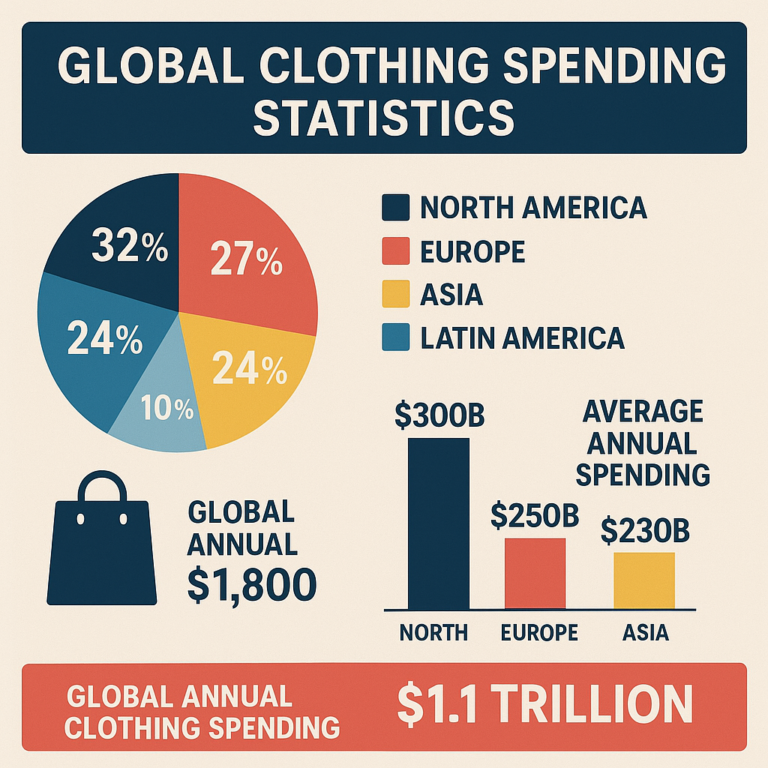
The global fashion industry is valued at approximately $1.7 to $1.84 trillion. If this industry were a nation, it would be the seventh-largest economy in the world.
- US Share: The US accounts for roughly 20-24% of the global apparel market.
- China’s Role: China is the world’s largest producer and a massive consumer, but the US remains the second-largest importer of clothing globally.
Import vs. Export Dynamics
The US is a net importer.
- 2020 Clothing Imports: $86 billion (16.8% of world imports).
- 2020 Textile Imports: $45 billion.
- Exports: Total US textile and apparel exports exceeded $12.5 billion in 2024.
This imbalance highlights a critical reality: the US designs and sells, but the world sews. While we export high-tech industrial textiles (like medical fabrics and non-wovens), our consumer clothing is overwhelmingly imported.
Did you know? Nearly 20% of “Made in USA” manufacturers explicitly use imported components. The supply chain is a global web, not a local loop.
👗 Women’s Apparel Market: The Undisputed Leader in US Sales
If you think the fashion industry is a democracy, think again. It’s a monarchy, and Women’s Apparel sits on the throne.
Market Share Breakdown
Globally and in the US, Womenswear dominates the landscape.
- Global Share: 53% of total retail spending.
- US Dominance: Women’s fashion consistently outpaces menswear and childrenswear in both volume and value.
Why Women Lead the Pack
It’s not just about the number of items; it’s about the frequency of purchase. Women tend to buy more frequently, experiment with trends more often, and have a wider variety of occasions to dress for (work, casual, formal, athletic, etc.).
Menswear holds a steady 31% share, driven largely by basics and the rising “athleisure” trend. Childrenswear rounds out the market at 16%, fueled by the fact that kids grow out of clothes faster than we can buy them!
The Rise of “She-Conomy”
Brands are waking up to the power of the female consumer. From Nike’s women-specific lines to Lulemon’s community-driven marketing, the industry is pivoting to cater to female preferences, sustainability concerns, and body positivity.
📈 United States Clothing Sales Trends and Revenue Projections
What’s hot, what’s not, and where is the money going? Let’s look at the trends shaping the US sales landscape.
The Shift to Experiential Retail
While online sales are booming, 58% of consumers still prefer shopping in-store for apparel. Why? Because fashion is tactile. You need to feel the fabric, try the fit, and see the color in real light.
- Hybrid Models: Brands are adopting “click-and-colect” and “buy online, return in-store” models to bridge the gap.
The Rise of Direct-to-Consumer (DTC)
Traditional retail is facing pressure. DTC brands like Warby Parker (glasses, but same model) and Everlane (clothing) have disrupted the market by cutting out the middleman. They offer transparency on pricing and manufacturing, appealing to the modern, informed shopper.
Revenue Projections
- 2025 Growth: Expected to reach $1.84 trillion globally, with the US contributing a significant chunk.
- E-commerce Share: Online purchases now account for nearly 21% of total fashion retail sales worldwide, with the US being a top contributor alongside China and the UK.
👥 Demographic Deep Dive: Who Buys the Most Clothes in America?
Who is actually opening their wallets? It’s not who you might think.
The Generational Wealth Gap
Here’s a twist: While Gen Z and Millennials are the loudest voices in fashion, the Silver Generation (50+) holds 72% of US wealth.
- Spending Power: Older demographics have higher disposable income and are increasingly investing in premium and sustainable brands.
- The “Quiet Luxury” Trend: This demographic is driving the trend toward timeless, high-quality pieces over fast fashion logos.
Age-Based Shopping Habits
- Gen Z (18-26): The champions of second-hand shopping (43% shop often) and user-generated content trust. They value authenticity and sustainability.
- Millennials (27-42): The bridge generation. They balance online convenience with in-store experiences and are the primary drivers of the athleisure boom.
- Gen X (43-58): Loyal to brands but increasingly conscious of value and quality.
- Bomers (59+): High spenders, less influenced by social media trends, more focused on comfort and fit.
💸 Average Expenditure on Clothing and Footwear per Household
Let’s talk numbers. How much does the average American family spend on looking good?
The Annual Bill
- Monthly Average: $162 per month.
- Annual Total: $1,945 per household.
That’s a lot of denim! And it’s not just going up; spending trends show a 10.9% increase in 2023, following a 2.3% increase in 2021.
Comparative Spending
To put this in perspective, US households spend:
- 45.7% more on clothing than on education.
- 124.5% more on clothing than on personal care.
- 23.4% more on clothing than on alcoholic beverages.
Footwear saw the largest component increase at 18.8%, proving that a good pair of sneakers is worth the investment.
🛒 Online vs. Offline: The Battle for Fashion Retail Dominance
The age-old question: In-store or Online? The answer is… both.
The In-Store Experience
Despite the digital boom, 58% of consumers prefer shopping for apparel in-store.
- Why? The ability to try things on, the immediate gratification, and the social aspect of shopping with friends.
- The “Showroom” Effect: Many stores are becoming showrooms where you browse, try on, and order online for home delivery if your size isn’t in stock.
The Online Surge
- Research Phase: 61% of shoppers research online or on social media before making a purchase, regardless of where they buy.
- Convenience: Online shopping wins on variety and ease of price comparison.
- Top Platforms: Amazon and Target are the most visited sites for apparel in the US.
The Hybrid Future
The future isn’t one or the other; it’s omnichannel. Brands that seamlessly integrate their online and offline experiences are winning. Think of Nordstrom or Zara, where you can buy online and return in-store, or reserve items to try on in the fitting room.
👔 Employment in Fashion: How Many People Work in the Industry?
Fashion isn’t just about models and designers; it’s a massive employer.
The Numbers
- Global Workforce: The sector employs over 60 million people in production and up to 30 million along the entire value chain.
- US Manufacturing: Total manufacturing employment (textiles and apparel) stands at 270,70 (2024), a 18.4% decrease from 2019.
- Retail Dominance: Clothing Retailers dominate the sector’s workforce, accounting for over 75.7% of total employment in the US.
The Shift in Jobs
While manufacturing jobs have declined, retail, design, marketing, and logistics jobs are growing. The industry is shifting from “making” to “moving and selling.”
Fun Fact: Approximately 76% of US apparel mills have fewer than 10 employees. These are the “micro-factories” keeping the “Made in USA” dream alive.
🚀 Success Rates: What It Takes to Launch a Clothing Brand in the US
Thinking of starting your own label? Hold onto your hat. The odds are stacked against you.
The Survival Stats
- 10% of clothing startups survive long-term.
- 30% fail within the first two years.
- 50% cannot survive past the 5-year mark.
- 70% cannot survive the 10-year mark.
Why Do They Fail?
- Capital Intensity: Inventory costs, marketing, and logistics eat up cash fast.
- Market Saturation: The barrier to entry is low, meaning the market is flooded with new brands.
- Supply Chain Issues: Sourcing quality materials and managing production timelines is a nightmare for beginners.
Keys to Success
- Niche Down: Don’t try to be everything to everyone. Find a specific audience.
- Storytelling: Consumers buy stories, not just clothes.
- Agility: Be ready to pivot based on trends and feedback.
🏭 Production Numbers: How Many Clothes Are Made Every Year?
The sheer volume of clothing produced is staggering.
Global Production
- Annual Output: The industry produces between 10 to 150 billion items of clothing annually.
- Consumption: Consumers buy over 80 billion new pieces of clothing every year—a 40% increase from two decades ago.
The US Context
- Domestic Production: Only 2.5% of apparel sold in the US is made domestically.
- Import Reliance: Over 97% of clothing is imported from countries like China, Bangladesh, and Vietnam.
This massive production volume is a double-edged sword: it makes fashion affordable but contributes significantly to environmental waste.
🧥 Wardrobe Overload: How Many Clothes Does the Average Person Own?
We buy a lot, but do wear it?
The Stats
- Average Wardrobe Size: Approximately 148 items.
- Utilization Rate: People do not wear at least 50% of their wardrobes.
- Annual Purchase: The average US consumer purchases 53 items per year.
- Average Item Cost: $16.04 per item (a testament to the fast-fashion model).
The “Closet Ghost” Phenomenon
We buy clothes for the version of ourselves we want to be, not the one we are. That yoga outfit from 2019? Still in the closet. That dress for the “weding we’ll definitely go to”? Hanging in the back.
🌍 Global Consumption: Which Country Eats Up the Most Apparel?
Who is the biggest fashion consumer on the planet?
The Rankings
- China: 40 billion units (2017 data).
- United States: 17 billion units.
- India: 6 billion units.
While China leads in volume due to its massive population, the US leads in per capita spending and value. Americans are willing to pay more for brand names and trends, driving the high market value.
🛍️ The Modern Shoper: What US Consumers Look for When Buying Clothes
What drives a sale in 2025? It’s not just the logo.
Top Decision Factors
- Price (83%): The undisputed king. If it’s too expensive, it’s a no-go.
- Ratings and Reviews (7%): Surprisingly low, but growing in importance.
- Brand Name: Considered one of the least important factors. Shoppers are open to lesser-known brands if the price and quality are right.
The “Value” Equation
Modern consumers are looking for the perfect balance of quality, price, and ethics. They want to feel good about their purchase, but not at the expense of their wallet.
📱 Trust Factors: User-Generated Content vs. Brand Marketing
Gone are the days of glossy magazine ads. Today, real people rule.
The Trust Gap
- 65% of consumers trust user-generated content (UGC) over brand-generated content.
- 85% of shoppers aged 18–34 find UGC important.
- 46% of those over 5 find it important.
Where Do We Look?
- Retail Websites: 35%
- Brand Websites: 34%
- Browser Search Results: 27%
- Social Feds: 20%
- In-Store Displays: 2%
Pro Tip: If you’re a brand, get your customers to post photos of your clothes. It’s the most effective marketing you can do.
🌱 Sustainability Shift: How Important is Eco-Friendly Fashion to Americans?
Sustainability is the buzzword of the decade, but is it a priority?
The Sentiment
- 57% of apparel shoppers believe it is very important for a brand to be sustainable.
- 40% prioritize personal needs/preferences over sustainability when purchasing.
- 27% buy from both sustainable and fast-fashion brands.
- 18% have a clear preference for sustainable clothing.
The “Say-Do” Gap
There’s a disconnect between what people say and what they do. While they want to be sustainable, price and convenience often win. However, the trend is shifting, with more brands adopting eco-friendly practices to meet this growing demand.
♻️ The Secondhand Boom: Market Value and Consumer Sentiment
The secondhand market is no longer just for thrift store hunters; it’s a billion-dollar industry.
Market Value
The global secondhand apparel market is projected to reach $7 billion by 2025, growing twice as fast as the overall apparel market.
Who’s Buying?
- Gen Z & Millennials: 43% shop second-hand “very often” or “often.”
- Older Generations: Only 1% of those over 5 shop second-hand frequently.
Why the Boom?
- Affordability: Getting high-quality brands for less.
- Sustainability: Reducing waste and carbon footprint.
- Uniqueness: Finding one-of-a-kind vintage pieces.
🏪 In-Store vs. Online: Where Do Americans Prefer to Shop?
We touched on this earlier, but let’s dig deeper into the channel preference.
The 58% Rule
58% of consumers prefer shopping for apparel in-store.
- The Experience: Touching the fabric, trying on sizes, and the social aspect.
- The Research: 61% research online first, then buy in-store (ROBO – Research Online, Buy Offline).
The Online Edge
- Convenience: Shop from your couch.
- Variety: Access to global brands and niche designers.
- Returns: Easy return policies have made online shopping less risky.
🗑️ The Dark Side: Apparel Waste and Environmental Impact Stats
We can’t talk about fashion without addressing the elephant in the room: waste.
The Stats
- Annual Waste: The average US consumer discards 81.5 pounds of clothes annually.
- Total Waste: Estimated 1.3 million tons of textile waste in the US.
- Recycling Rate: Only 1% of clothes are recycled globally.
- Decomposition: Textiles can take up to 20 years to decompose.
The Carbon Footprint
- Emissions: The fashion industry is responsible for 10% of annual global carbon emissions.
- Water Usage: 93 billion cubic meters of water annually (enough for 5 million people).
- Microfibers: Up to 50,0 tons of microfibers end up in the ocean every year.
The Export of Waste
15% of used textiles are shipped overseas, often ending up in landfills in developing countries due to less advanced waste management systems.
🏢 Corporate Fashion Solutions: Uniforms, Swag, and Team Stores
Beyond the consumer market, the B2B side of fashion is huge.
The Corporate Wardrobe
From uniforms for healthcare workers to swag for tech startups, corporate fashion is a massive industry.
- Team Stores: Companies are setting up internal “team stores” for employees to order branded gear.
- Distributor Portals: Streamlining the process of ordering and managing corporate apparel.
The Trend
There’s a shift towards sustainable corporate wear and customizable options that reflect company culture.
🔮 Brief Fashion Industry Insights and Predictions for 2025
What does the future hold?
AI and Technology
- Generative AI: 50% of fashion executives view generative AI as key for product discovery in 2025.
- Personalization: 82% of customers want AI to reduce shopping research time.
Market Competition
- Challenger Brands: Brands like Deckers, New Balance, and Vuori are projected to surpass giants like Nike and Adidas in profits by 2024.
- Sustainability: Expect more brands to adopt circular economy models (rental, resale, recycling).
The “Silver Economy”
With the Silver Generation holding 72% of US wealth, brands that cater to older demographics with style and comfort will see significant growth.
✅ Conclusion

So, how big is the fashion industry in the US? Huge. It’s a $365.70 billion powerhouse that drives global trends, employs millions, and shapes our daily lives. But it’s also a complex ecosystem facing challenges like sustainability, waste, and the decline of domestic manufacturing.
From the 83% of shoppers who prioritize price to the 65% who trust user-generated content, the modern consumer is savvy, value-driven, and increasingly conscious of the impact of their choices. The future of US fashion lies in hybrid models, sustainable practices, and technological innovation.
Our Recommendation: Whether you’re a shopper or a brand, the key is adaptability. For shoppers, embrace the secondhand market and support brands that align with your values. For brands, focus on authenticity, transparency, and agility. The fashion industry is evolving, and those who evolve with it will thrive.
🔗 Recommended Links
Ready to upgrade your wardrobe or start your brand? Check out these top picks:
- Sustainable Basics:
Everlane: Shop Everlane on Amazon | Everlane Official
Patagonia: Shop Patagonia on Amazon | Patagonia Official - Secondhand Finds:
ThredUp: Shop ThredUp
Poshmark: Shop Poshmark - Corporate & Team Wear:
Custom Ink: Custom Ink Team Store
Vistaprint: Vistaprint Apparel
Books to Read:
- The True Cost by Andrew Morgan (Documentary companion)
- Loved Clothes Last by Orsola de Castro
❓ FAQ

What is the projected growth of the US fashion industry by 2025?
The US apparel market is projected to grow at a Compound Annual Growth Rate (CAGR) of 2.1% between 2025 and 2028, reaching a valuation of $365.70 billion in 2025. This steady growth is driven by e-commerce expansion and the rise of sustainable fashion.
Read more about “🛹 15+ Top Clothing Brands for Streetwear to Rule 2026”
Which US clothing brands are leading the market in 2024?
While Nike and Adidas remain giants, challenger brands like Deckers, New Balance, and Vuori are gaining significant market share and are projected to surpass established giants in profits. In the fast-fashion sector, Shein and Amazon dominate online sales, while Target and Walmart lead in value retail.
Read more about “🧵 7 Pillars of Women’s Clothing Market Segmentation (2026)”
How does the US fashion industry compare to global markets?
The US is the second-largest apparel retail market in the world (after China) and the second-largest importer of clothing. It accounts for roughly 20-24% of the global market. Unlike China, which is a production hub, the US is primarily a consumption and design hub, with 97.5% of its clothing imported.
What are the top fashion trends driving sales in the US this year?
- Sustainability: Growing demand for eco-friendly and second-hand clothing.
- Athleisure: Comfortable, versatile clothing for work and play.
- Quiet Luxury: High-quality, timeless pieces over loud logos.
- AI-Driven Personalization: Shoppers expect tailored recommendations and faster research.
Read more about “🌍 Global Womenswear Market Size: The $1T Future (2026)”
Why is the “Made in USA” label so rare?
Domestic manufacturing has declined due to high labor costs and the availability of cheaper labor overseas. Only 2.5% of apparel sold in the US is made domestically. Most US manufacturers are now micro-factories focusing on samples, prototypes, or high-end basics, rather than mass production.
📚 Reference Links
- Global Fashion Industry Statistics: FashionUnited
- US Fashion Industry Association: US Fashion Industry Association
- Bureau of Labor Statistics: Textile and Apparel Manufacturing Employment
- McKinsey & Company: The State of Fashion 2025
- Ellen MacArthur Foundation: A New Textiles Economy
- Levi Strauss & Co: Levi’s Official Site
- Nike: Nike Official Site
- Amazon Fashion: Shop Fashion on Amazon