Support our educational content for free when you purchase through links on our site. Learn more
💰 US Fashion GDP Revealed: The $365B Truth (2026)

The U.S. fashion industry contributes a staggering $365.7 billion to the national economy, driven not by sewing machines but by design, branding, and retail power. When you ask What is the GDP of the fashion industry in the US?, the answer reveals a massive service-based engine that employs millions while importing the vast majority of its physical goods.
Imagine a single American woman opening her closet to find 103 pieces of clothing, yet wearing less than half of them. This paradox of abundance and waste fuels a market where consumer spending hits nearly $380 billion annually, reshaping how we view economic value.
We often assume “Made in USA” means the clothes are stitched here, but only 2.5% of apparel sold in the States is actually manufactured domestically. The real economic magic happens in the boardrooms of New York and the checkout lines of retail giants, turning global supply chains into local GDP growth.
Key Takeaways
- Massive Economic Impact: The U.S. apparel market is valued at approximately $365.7 billion, making it the second-largest retail market globally.
- Service Over Manufacturing: While manufacturing jobs have plummeted, the industry thrives on design, marketing, and retail services that add significant value domestically.
- Consumer Power: Americans spend roughly $1,945 per household annually on clothing, yet discard 81.5 pounds of textiles each year.
- Global Reliance: Despite the huge GDP contribution, the U.S. relies on imports for 97.5% of its clothing, highlighting a shift from production to brand value.
Table of Contents
- ⚡️ Quick Tips and Facts
- 📜 From Hemlines to Headlines: A Brief History of US Fashion Economics
- 🇺🇸 The Big Number: What is the GDP of the Fashion Industry in the US?
- 📊 Fashion Industry Statistics: General Data Breakdown
- 🏢 Fashion Industry Statistics: The Companies Driving the Market
- 👗 Fashion Industry Statistics: Job Creation and Workforce Impact
- 📈 Market Trends: How Consumer Spending Shapes the GDP
- 🌐 Global Context: US Fashion GDP vs. International Competitors
- 🚀 Future Outlook: Sustainability and Tech’s Role in Economic Growth
- 💡 Quick Tips and Facts
- 🏁 Conclusion
- 🔗 Recommended Links
- ❓ FAQ
- 📚 Reference Links
⚡️ Quick Tips and Facts
Before we dive into the nitty-gritty of balance sheets and supply chains, let’s hit the rewind button on some common misconceptions. You might think the fashion industry is just about runway shows and red carpets, but the economic engine humming beneath the surface is massive.
Here is the tea on the US fashion economy:
- The “Made in USA” Myth: Only 2.5% of clothing sold in the U.S. is actually manufactured here. That’s right, the vast majority of your wardrobe likely traveled thousands of miles to reach your closet.
- The Job Market Shift: In 190, the U.S. boasted nearly 1 million apparel manufacturing jobs. By 2025, that number is projected to plummet to less than 10,0. It’s a stark reminder of how globalization has reshaped our local economy.
- Consumer Spending Power: The average American household spends roughly $1,945 per year on apparel. That’s more than they spend on education or personal care!
- The Global Giant: If the global fashion industry were a country, it would be the seventh-largest economy in the world, sitting right behind Germany and India.
- Wardrobe Waste: The average American woman owns 103 pieces of clothing, yet studies suggest wear less than 50% of what we own.
For a deeper dive into how these numbers affect your wallet and the planet, check out our detailed breakdown on US Fashion Industry Statistics.
📜 From Hemlines to Headlines: A Brief History of US Fashion Economics
The story of American fashion isn’t just about who wore what at the Met Gala; it’s a saga of industrial revolution, wartime rationing, and the relentless march of globalization.
The Golden Age of Domestic Manufacturing
Back in the early 20th century, the “Made in USA” label was the gold standard. Cities like New York’s Garment District were the beating heart of the global fashion world. We had the raw cotton from the South, the mills in the North, and the designers in the city. It was a closed loop of economic prosperity.
The Great Shift
However, the tide turned in the late 20th century. As labor costs in the U.S. skyrocketed, brands began looking overseas. The North American Free Trade Agreement (NAFTA) and later the World Trade Organization (WTO) agreements opened floodgates for imports.
“It’s essential for Round House jeans to have retailers selling products that were made outside of the US,” says an industry veteran, highlighting the brutal economic reality. “We haven’t been able to survive without offering at this price point, who would be?”
This sentiment echoes the struggle of companies like Round House, a 12-year-old manufacturer of bib overalls. While their U.S.-made overalls cost $70, comparable imported versions sit at $40. To survive, they’ve had to adapt, keeping a foot in both worlds.
The Modern Landscape
Today, the U.S. fashion economy is a hybrid beast. We design the trends in New York and Los Angeles, but we manufacture the volume in Asia and Central America. The GDP contribution has shifted from production value to brand value and retail sales.
🇺🇸 The Big Number: What is the GDP of the Fashion Industry in the US?
So, you asked the million-dollar question: What is the GDP of the fashion industry in the US?
Here is the tricky part: The U.S. Bureau of Economic Analysis (BEA) doesn’t publish a single line item called “Fashion Industry GDP.” Instead, the industry’s contribution is scattered across several sectors: Textile Mills, Apparel Manufacturing, Retail Trade, and Wholesale Trade.
Piecing Together the Puzzle
When we aggregate the data from the Joint Economic Committee and other economic reports, we get a clearer picture:
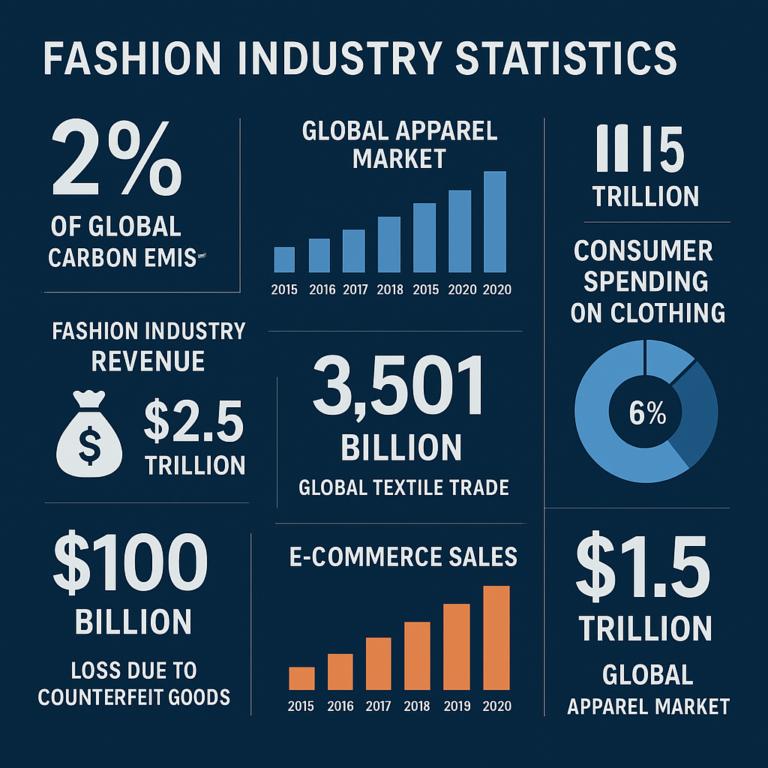
- Consumer Spending: In recent years, U.S. consumers have spent nearly $380 billion annually on apparel and footwear.
- Total Economic Impact: When you factor in the supply chain, logistics, marketing, and retail operations, the total economic impact is estimated to be significantly higher, often cited around $365.70 billion for the apparel market alone in 2025 projections.
- Global Context: While the global apparel market accounts for roughly 1.63% to 1.65% of the world’s GDP, the U.S. remains the second-largest apparel retail market globally, trailing only China.
Why the confusion?
Many sources conflate “Apparel Market Size” with “GDP Contribution.” Market size is the total value of goods sold. GDP contribution includes the value added at each stage of production. In the U.S., since most manufacturing happens abroad, the value added domestically comes largely from design, branding, and retail margins.
Key Insight: The U.S. fashion industry is less of a manufacturing powerhouse and more of a service and brand powerhouse. We export ideas and import goods.
📊 Fashion Industry Statistics: General Data Breakdown
Let’s crunch the numbers. The data tells a story of resilience, shifting consumer habits, and a market that refuses to shrink.
Market Size and Growth
- Current Valuation: The U.S. apparel market is valued at approximately $365.70 billion (2025 estimate).
- Growth Rate: The market is projected to grow at a CAGR of 2.1% between 2025 and 2028.
- Monthly Sales: Retail clothing sales in the U.S. average $25.63 billion per month.
Consumer Behavior Stats
- In-Store vs. Online: Despite the e-commerce boom, 58% of consumers still prefer shopping for apparel in-store.
- Price Sensitivity: A staggering 83% of U.S. shoppers cite price as the most crucial factor in purchasing decisions.
- Trust Factors: 65% of consumers trust user-generated content (UGC) over brand-generated content.
The Wardrobe Reality
- Ownership: The average American woman owns 103 pieces of clothing.
- Usage: We wear less than 50% of our wardrobes.
- Waste: The average U.S. consumer discards around 81.5 pounds of clothes annually, contributing to an estimated 1.3 million tons of textile waste in the country.
| Metric | Statistic | Source Context |
|---|---|---|
| Avg. Household Spend | $1,945 / year | Uniform Market |
| Monthly Retail Sales | $25.63 Billion | Bureau of Economic Analysis |
| In-Store Preference | 58% | Uniform Market |
| Price Sensitivity | 83% | Uniform Market |
| Textile Waste | 81.5 lbs / person | Uniform Market |
🏢 Fashion Industry Statistics: The Companies Driving the Market
Who are the titans pulling the strings of this $365 billion market? It’s a mix of legacy giants and agile disruptors.
The Heavyweights
- Nike: Consistently ranks as the top apparel brand by value. With a market cap often exceeding $20 billion, Nike dominates the athletic sector.
- LVMH (Louis Vuiton Moët Henessy): While global, their U.S. presence is massive. They hold the top spot in luxury, with brands like Louis Vuiton, Dior, and Givenchy.
- TJX Companies: The parent of T.J. Max and Marshalls, TJX is a retail giant that thrives on the “off-price” model, capturing the price-sensitive consumer.
The Challengers
Don’t sleep on the disruptors. Brands like Deckers (Ugg, Hoka), New Balance, and Vuori are gaining ground. Some analysts predict these challenger sportswear brands may surpass giants like Nike and Adidas in profits by 2024 due to their niche focus and agility.
The Startup Survival Rate
It’s a brutal game for new entrants.
- 10% of clothing startups survive long-term.
- 30% fail within the first two years.
- 50% fail past the 5-year mark.
For a deep dive into how these brands stack up against each other, check out our Brand Quality Comparisons.
👗 Fashion Industry Statistics: Job Creation and Workforce Impact
We touched on the manufacturing decline earlier, but the job landscape is more nuanced than just “jobs lost.”
The Shift in Roles
- Manufacturing: As noted, manufacturing jobs have dropped from nearly 1 million in 190 to under 10,0 today.
- Design & Marketing: Conversely, roles in fashion design, digital marketing, e-commerce management, and sustainability consulting have surged.
- Retail: The retail sector still employs a massive workforce, though the nature of the job is changing with the rise of omnichannel experiences.
Salary Insights
- Fashion Designers: Earn an average of $78,870 annually, making them among the highest-paid creative professionals in the sector.
- Sewing Machine Operators: Wages have stagnated, reflecting the shift of this role to lower-cost countries.
The Human Cost
While the industry creates opportunities, we must acknowledge the dark side. Globally, there are denunciations of workers trapped in “modern-day slavery” in sweatshops. The U.S. fashion industry, while largely white-collar domestically, is deeply entangled in global supply chains where labor rights are often violated.
Did you know? The global textile, clothing, leather, and footwear industries employ more than 60 million people worldwide, but the distribution of wealth is heavily skewed.
📈 Market Trends: How Consumer Spending Shapes the GDP
The GDP of the fashion industry is directly tethered to what you, the consumer, decide to buy. And right now, your wallet is telling a complex story.
The “Silver Generation” Opportunity
- Wealth Holders: The “Silver Generation” (50+) holds 72% of U.S. wealth.
- Spending Power: This demographic is increasingly active in the fashion market, driving demand for comfort, quality, and timeless style over fast fashion.
The Gen Z & Millennial Shift
- Online Dominance: 82% of shoppers aged 26–35 have purchased clothes online in the last 12 months.
- Sustainability: 57% of shoppers believe it is very important for a brand to be sustainable. However, 63% of fashion brands are laging behind 2030 decarbonization goals.
The Price Paradox
Despite the desire for sustainability, 83% of shoppers still prioritize price. This creates a tension where brands like Patagonia (known for sustainability) compete with fast fashion giants like Shein on price, often losing the battle for the mass market.
👉 Shop Sustainable Brands on:
- Patagonia: Amazon | Official Site
- Reformation: Official Site
🌐 Global Context: US Fashion GDP vs. International Competitors
How does the U.S. stack up against the rest of the world?
The Rankings
- Market Size: The U.S. is the second-largest apparel retail market, behind China.
- Import/Export: The U.S. is the second-largest importer of clothing globally (approx. $86 billion in 2020) and the fifth-largest exporter of textiles.
- Global Share: The U.S. accounts for roughly 24.67% of the total global economy (nominal GDP), making it a massive consumer market.
The Asian Dominance
- Market Share: The Asian market is forecast to hold a 38% share of global apparel demand.
- Production Hub: China, India, and Bangladesh remain the primary manufacturing hubs, producing the bulk of the world’s garments.
The European Luxury Hold
- Luxury Power: European conglomerates like LVMH and Kering (Gucci, Saint Laurent) dominate the high-end market, capturing a disproportionate share of the global GDP contribution from fashion.
🚀 Future Outlook: Sustainability and Tech’s Role in Economic Growth
Where is the industry heading? The future of the U.S. fashion GDP depends on two main pillars: Technology and Sustainability.
Tech as a Growth Engine
- Generative AI: 50% of fashion executives view generative AI as key for product discovery in 2025. This tech can streamline design, reduce waste, and personalize shopping experiences.
- Virtual Try-Ons: AR and VR are becoming standard, reducing return rates and boosting online conversion.
The Sustainability Imperative
- Decarbonization: With the industry responsible for 10% of annual global carbon emissions, the push for green manufacturing is no longer optional.
- Recycling: Currently, only 1% of clothes are recycled annually. The future GDP growth will likely come from the circular economy—resale, rental, and recycling.
The Big Question: Can the U.S. fashion industry pivot to a sustainable model without sacrificing the low prices consumers demand? We’ll explore this tension in our conclusion.
💡 Quick Tips and Facts (Recap)
Just to ensure you’ve got the highlights locked in:
- 2.5% of U.S. clothing is made in the U.S.
- $365.70 billion is the projected market size for 2025.
- 103 pieces is the average wardrobe size for an American woman.
- 81.5 pounds of clothes are thrown away person annually.
For more on how to build a sustainable wardrobe, check out our Affordable Fashion Brands guide.
👉 Shop Affordable Essentials on:
- Uniqlo: Amazon | Official Site
- Everlane: Official Site
🏁 Conclusion

So, what is the GDP of the fashion industry in the US? It’s not a single number you can scribble on a napkin. It’s a complex ecosystem worth nearly $365 billion in direct market size, driven by a consumer who spends nearly $2,0 a year on clothes but owns 103 items and wears half of them.
The narrative we started with—the decline of manufacturing jobs and the rise of global imports—has evolved. The U.S. fashion industry has successfully pivoted from a manufacturing economy to a brand and service economy. We design the dreams, market the lifestyle, and sell the experience, while the heavy lifting of sewing happens elsewhere.
The Positives:
- ✅ Massive economic contribution and job creation in design, marketing, and retail.
- ✅ High wages for creative professionals.
- ✅ A resilient market that continues to grow despite global headwinds.
The Negatives:
- ❌ The loss of domestic manufacturing jobs and the hollowing out of the industrial base.
- ❌ Significant environmental impact and textile waste.
- ❌ Ethical concerns regarding global supply chains.
Our Confident Recommendation:
As stylists at Clothing Brands™, we believe the future lies in conscious consumption. The GDP of the fashion industry will only be truly sustainable if we shift our spending habits. Support brands that are transparent about their supply chains, invest in quality over quantity, and embrace the circular economy.
The question isn’t just “How much is the GDP?” but “What is the cost of that GDP?” It’s time to direct our power for the good, as the industry leaders suggest, causing less impact on people’s lives and the environment’s health.
🔗 Recommended Links
Ready to upgrade your wardrobe with brands that align with these values? Here are our top picks:
- Sustainable Essentials:
Patagonia: Amazon | Official Site
Reformation: Official Site - Affordable Quality:
Uniqlo: Amazon | Official Site
Everlane: Official Site - Books for Further Reading:
The True Cost by Andrew Morgan (Documentary companion) – Amazon
Loved Clothes Last by Orsola de Castro – Amazon
❓ FAQ

What is the market size of the US fashion industry in 2024?
The U.S. apparel market is valued at approximately $365.70 billion in 2025, with a steady growth rate projected through 2028. This figure represents the total value of goods sold, which is the primary driver of the industry’s economic footprint.
Read more about “🇺🇸 How Big is the Fashion Industry in the US? (2026)”
How much does the fashion industry contribute to the US economy?
While a specific “GDP” line item doesn’t exist, the industry’s contribution is massive. Consumer spending on apparel and footwear is nearly $380 billion annually. When including the broader supply chain, retail, and marketing, the total economic impact is significantly higher, making it a cornerstone of the U.S. service economy.
Read more about “🌍 How Big Is the Fashion Industry Market? (2026)”
What are the fastest growing clothing brands in the US?
Challenger brands like Deckers (Ugg, Hoka), New Balance, and Vuori are experiencing rapid growth. These brands are capitalizing on the demand for comfort, performance, and niche aesthetics, often outpacing legacy giants in profit growth.
Read more about “🏆 Who Sells the Most Apparel in the US? (2026)”
Which US fashion brands have the highest revenue?
Nike consistently leads the pack in revenue and market capitalization. In the retail sector, TJX Companies (T.J. Max, Marshalls) and Amazon (as a retailer) are massive revenue generators. In luxury, while many are global, their U.S. operations are significant, with LVMH brands leading the high-end market.
How does the US compare to China in fashion production?
China remains the world’s largest producer and consumer of apparel. The U.S. is the second-largest importer of clothing, relying heavily on Chinese and Asian manufacturing. However, the U.S. leads in brand value and retail innovation.
Is the US fashion industry becoming more sustainable?
Progress is being made, but it’s slow. 63% of brands are laging behind 2030 decarbonization goals. However, consumer demand is shifting, with 57% of shoppers prioritizing sustainability, forcing brands to adapt their supply chains.
Read more about “🏆 Which Country Has the Biggest Fashion Industry? (2026)”
📚 Reference Links
- Fashion United: Global Fashion Industry Statistics – Comprehensive data on global market trends.
- Fash Innovation: Fashion Industry Statistics – Insights on economic impact and labor.
- Uniform Market: Global Apparel Industry Statistics – Detailed consumer behavior and market size data.
- Nike: Nike Official Website
- LVMH: LVMH Official Website
- Patagonia: Patagonia Official Website
- U.S. Bureau of Economic Analysis: Industry Data